Quick answer: use beech or rubberwood for small parts that take knocks, pine for painted bodies and cost-sensitive ranges, plywood for panels that need to stay flat and strong, and E1-grade MDF for smooth painted surfaces and complex shapes. The finish and the edge treatment matter as much as the species.
Wooden toy buyers often ask for “solid wood” as a proxy for quality. Solid wood is good, but it is not the right answer for every part. A plywood panel can be stronger and more stable than a solid board; MDF can hold a painted shape that solid wood cannot. The skill is matching the material to the part.
The four materials we use
| Material | Best for | Watch-outs |
|---|---|---|
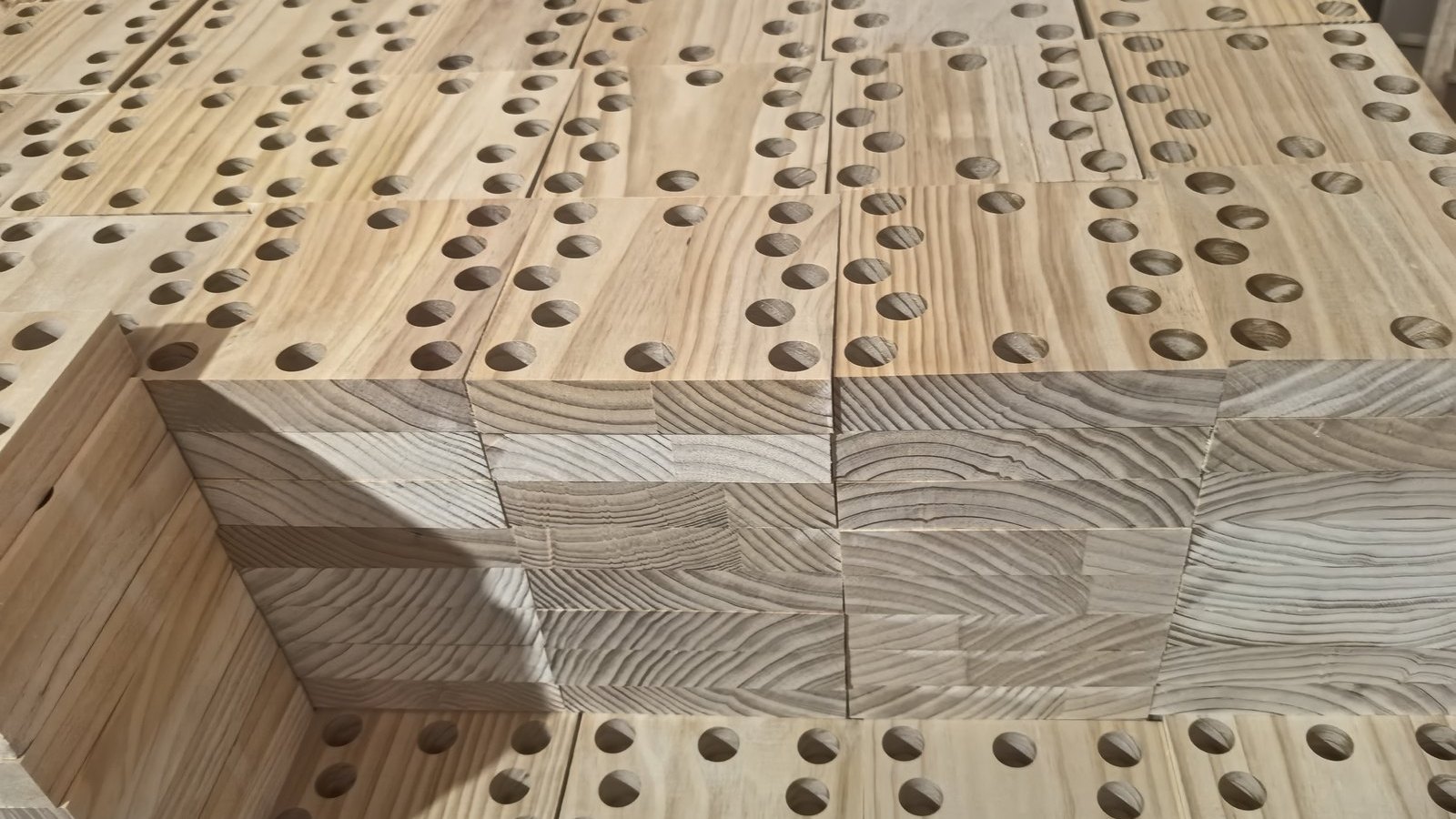
| Beech | Blocks, wheels, small parts, chess pieces, handles | Hard and heavy; takes a fine sand; can be expensive. |
| Pine | Painted bodies, rocking horses, easels, cost-sensitive ranges | Softer; knots and grain can show through paint; needs a good primer. |
| Plywood | Panels, play kitchens, dollhouse walls, climbing frames | Edge quality matters; cheap plywood can delaminate in humidity. |
| E1 MDF | Smooth painted panels, curved shapes, puzzle trays | Heavy; screws need reinforcement; dust control in the workshop. |
Strength and the play action
A balance bike frame takes a different load from a puzzle piece. The frame needs screw-holding strength at the joints and enough flex to absorb a curb; beech or a hardwood plywood is usually the right choice. A puzzle piece needs a clean cut and a stable print surface; MDF or plywood is often better than a soft solid wood.
Moisture and the destination market
Wood moves with humidity. A solid-wood panel that is fine in a dry warehouse can cup in a humid port. Plywood and MDF are more dimensionally stable, which is why they are common in furniture and dollhouses. If your market is tropical, tell the supplier at quotation stage and ask for a moisture-content check and a sealed edge.
Paint, print and the finish
Water-based paint adheres differently to pine, beech, plywood and MDF. A soft wood needs a primer and a sand between coats; MDF needs a sealed edge to avoid a fuzzy finish. A direct print works best on a flat, stable panel. For a natural finish, an oil or a clear water-based lacquer shows the grain; for a painted finish, the grain is usually hidden.
Cost and the price point
Material is one part of the cost; labour and finishing are often bigger. A beech block set costs more in material than a pine set, but the difference at retail can be justified by the feel and the durability. A painted MDF kitchen can hit a lower price point than a solid-wood kitchen without looking cheap, if the edge and the paint are right.
What to put in the specification
- Species or board type for each part, not just “wood”.
- Board thickness and tolerance.
- Moisture content for solid wood.
- Edge treatment: sanded, sealed, painted or lipped.
- Paint or finish system, and the test standard it must meet.
- Any parts that must be metal, magnet or fabric.
The short version
Match the material to the part and the market. Beech for knocks, pine for painted value, plywood for stable panels, MDF for smooth shapes. Specify the edge and the finish, not just the species. Then test the exact combination — a material change can invalidate a test report.
Frequently asked questions
Is MDF safe for children's toys?
E1-grade MDF with a water-based finish and sealed edges is widely used in toys and furniture. The important points are the board grade, the edge seal and the paint compliance.
Is solid wood always better?
No. Solid wood is excellent for certain parts, but it can warp in large panels. Plywood or MDF can be the better engineering choice for a dollhouse wall or a kitchen panel.
Does the material change the test report?
Yes. A change of substrate or paint can require a new EN71-3 or ASTM test. Tell the supplier before the change, not after.
Which wood is best for a balance bike?
A hardwood such as beech, or a high-quality hardwood plywood for the frame, with a water-based finish. Soft pine is not ideal for the main frame.